 Maana Wellness
Does Cryotherapy Actually Speed Up Recovery? Here’s What the Research Shows
Written by Shilpa Sunny. Reviewed for clinical accuracy by Jasmal K.
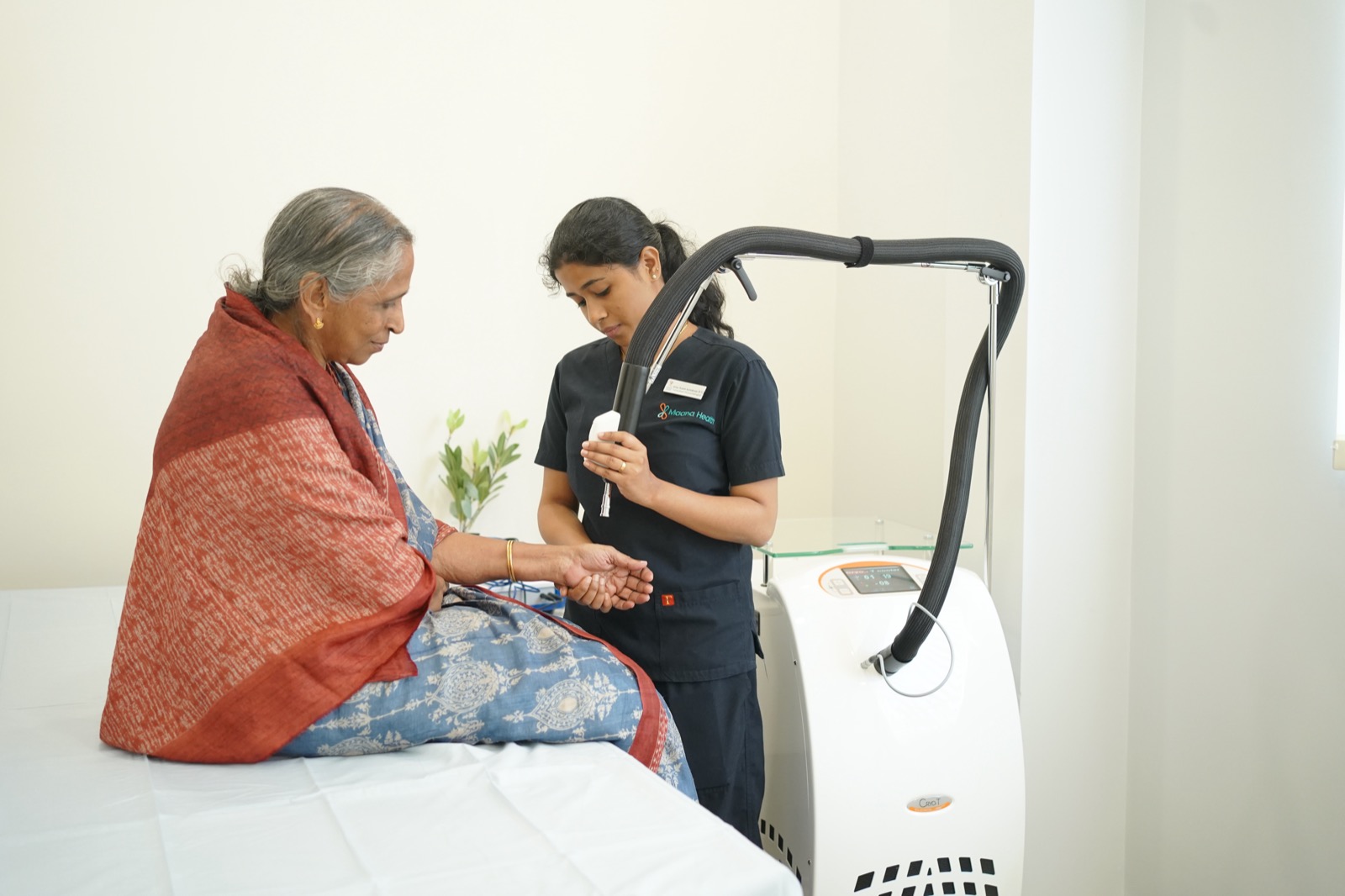
Cold therapy reliably makes you feel less sore after exercise — the evidence for that is strong and consistent. Whether it measurably speeds up your body’s actual physiological recovery is a separate question, and the evidence there is much less clear.
The Short Version
A large meta-analysis pooling 27 studies found cooling significantly reduced delayed-onset muscle soreness (DOMS) at 24, 48, and 96 hours after exercise, and significantly reduced perceived exertion at 24 hours. The same analysis found no significant effect on any objective recovery variable over that same period — meaning blood markers and other measurable physiological indicators didn’t show a clear benefit, even though people reported feeling less sore.
What the Research Shows
A systematic review and meta-analysis (published in PLOS One) pooling data from 27 studies on post-exercise cooling found a significant reduction in DOMS symptoms compared to non-cooling control conditions, with the effect holding at 24, 48, and 96 hours after exercise. Perceived exertion (RPE) was also significantly reduced, though only at the 24-hour mark. Critically, the same review found no evidence that cooling significantly affected any objective recovery variable — the physiological markers researchers can actually measure, as opposed to what people report feeling — across the 96-hour recovery window studied.
A 2025/2026 systematic review and network meta-analysis (Frontiers in Sports and Active Living) is currently comparing different cryotherapy modalities — whole-body cryotherapy, cold water immersion, contrast water therapy, and local cold therapy — against DOMS, athletic performance, and inflammatory biomarkers at multiple time points, aiming to identify which specific cold-therapy method works best and when. This reflects an evolving, still-developing area of the literature rather than a single settled answer.
A separate systematic review (ScienceDirect) specifically examining cryotherapy duration found that how long the cold is applied matters for short-term recovery outcomes — an important practical detail, since not all cryotherapy protocols use the same exposure time.
The Honest Limitations
- Subjective relief and objective recovery are two different findings, and the strongest available meta-analysis found evidence for one but not the other. Marketing language that blurs “feels better” into “heals faster” isn’t well supported by this specific body of research.
- There’s a genuine, unresolved scientific debate about whether reducing inflammation right after exercise helps or actually blunts the body’s natural training adaptation — some research has suggested that suppressing the inflammatory and macrophage response too early may interfere with the normal muscle repair and adaptation process, though this remains an active area of study rather than settled science.
- Protocol and duration matter, and aren’t yet standardized across the field, similar to the pattern seen in several other modalities reviewed on this site.
The Bottom Line
Cryotherapy has strong, repeated evidence for one specific thing: it makes you feel less sore after hard exercise. That’s a real, well-documented effect, not a placebo artifact — it holds up across a meta-analysis pooling dozens of studies. What it hasn’t clearly been shown to do, at least in the most rigorous pooled analysis available, is measurably accelerate the underlying biological recovery process. Both of those are legitimate reasons to use cryotherapy — feeling better matters — but they’re different claims, and only one of them currently has strong objective support.
References
- The Effect of Post-Exercise Cryotherapy on Recovery Characteristics: A Systematic Review and Meta-Analysis. PLOS One. journals.plos.org/plosone
- Impact of different cryotherapy interventions on post-exercise acute delayed-onset muscle soreness, athletic performance, and inflammatory biomarkers: a systematic review and network meta-analysis. Frontiers in Sports and Active Living. frontiersin.org
- Cryotherapy duration is critical in short-term recovery of athletes: a systematic review. ScienceDirect. sciencedirect.com/science/article/pii/S2059775421000729